|
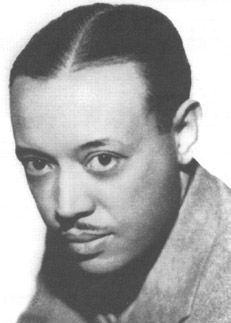
Long known as the
Dean of Black American composers, as well as one of America's
foremost composers, WILLIAM GRANT STILL had the
distinction of becoming a legend in his own lifetime. On May 11,
1895, he was born in Woodville, Mississippi, to parents who were
teachers and musicians of Black, Indian, Spanish, Irish, and
Scottish heritage. When William was only a few months old, his
father died and his mother took him to Little Rock, Arkansas,
where she taught English in high school. There his musical
education began with violin lessons from a private teacher, and
with later inspiration from Red Seal opera recordings bought
for him by his stepfather.
In Wilberforce University, he took courses leading to a
B.S. degree, but spent most of his time conducting the band,
learning to play various instruments, and making his initial
attempts to compose and to orchestrate. His subsequent studies at
the Oberlin Conservatory of Music were financed at first by a
legacy from his father, and later by a scholarship established
just for him by the faculty.
At the end of his college years, he entered the world of commercial (popular) music, playing in orchestras and orchestrating, working in particular with the violin, cello, and oboe. His employers included W.C. Handy, Don Voorhees, Sophie Tucker, Paul Whiteman, Willard Robison, and Artie Shaw, and for several years he arranged and conducted the “Deep River Hour” over CBS and WOR. |
|
While in Boston playing oboe in the "Shuffle Along" orchestra, Still applied to study at the New England Conservatory with George Chadwick, and was again rewarded with a scholarship due to Mr. Chadwick's own vision and generosity. He also studied, again on an individual scholarship, with the noted ultra-modern composer, Edgard Varèse.
In the 1920s, Still made his first appearances as a serious composer in New York, and began a valued friendship with Howard Hanson. Extended Guggenheim and Rosenwald Fellowships were given to him, as well as important commissions from the Columbia Broadcasting System, the New York World's Fair 1939-40, Paul Whiteman, the League of Composers, the Cleveland Orchestra, the Southern Conference Educational Fund and the American Accordionists Association. In 1944, he won the Jubilee prize of the Cincinnati Symphony for the best Overture to celebrate its Jubilee season, with a work called Festive Overture. In 1953, a Freedoms Foundation Award came to him for his To You, America! which honored West Point's Sesquicentennial Celebration. In 1961, he received the prize offered by the US Committee for the UN, the NFMC and the Aeolian Music Foundation for his orchestral work, The Peaceful Land, cited as the best musical composition honoring the United Nations.
After moving to Los Angeles in the early 1930s, citations from numerous organizations, local and elsewhere in the United States, came to the composer. Along with them came honorary degrees including Master of Music from Wilberforce in 1936; Doctor of Music from Howard University in 1941; Doctor of Music from Oberlin College in 1947; Doctor of Letters from Bates College in 1954; Doctor of Laws from the University of Arkansas in 1971; Doctor of Fine Arts from Pepperdine University in 1973; Doctor of Music from the New England Conservatory of Music, the Peabody Conservatory and the University of Southern California.
Among the awards Still has received have been the Harmon Award in 1927; a trophy of honor from Local 767 of the Musicians' Union AF of M, of which he was a member; trophies from the League of Allied Arts in Los Angeles (1965) and the National Association of Negro Musicians; citations from the Los Angeles City Council and Los Angeles Board of Supervisors (1963); a trophy from the APPA in Washington D.C. (1968); the Phi Beta Sigma George Washington Carver Award (1953); the Richard Henry Lee Patriotism Award from Knott's Berry Farm, California; a citation from the Governor of Arkansas in 1972; and the third annual prize of the Mississippi Institute of Arts and Letters in 1982. He also lectured in various universities from time to time.
In 1939 Still married journalist and concert pianist Verna Arvey who became his principal collaborator. They remained together until Still died of heart failure on December 3, 1978. ASCAP took care of all of Dr. Still's hospitalization until his death.
Dr. Still's service to the cause of brotherhood is evidenced by his many firsts in the musical realm: Still was the first Afro-American in the United States to have a symphony performed by a major symphony orchestra. He was the first to conduct a major symphony orchestra in the United States, when in 1936, he directed the Los Angeles Philharmonic in his compositions at the Hollywood Bowl. He was the first Afro-American to conduct a major symphony orchestra in the Deep South in 1955, when he directed the New Orleans Philharmonic at Southern University. He was the first of his race to conduct a White radio orchestra in New York City. He was the first to have an opera produced by a major company in the United States, when in 1949, his Troubled Island was done at the City Center of Music and Drama in New York City. He was the first to have an opera televised over a national network. With these firsts, Still was a pioneer, but, in a larger sense, he pioneered because he was able to create music capable of interesting the greatest conductors of the day: truly serious music, but with a definite American flavor. Still wrote over 150 compositions (well over 200 if his lost early works could be counted), including operas, ballets, symphonies, chamber works, and arrangements of folk themes, especially Negro spirituals, plus instrumental, choral and solo vocal works.
For more complete information, please visit www.williamgrantstillmusic.com |